
This deterioration in air quality led to prompting enforcement of Stage II of the Graded Response Action Plan (GRAP) in the national capital.

At least 23 people, including children, were killed as relentless rain triggered one of the worst landslides in a decade in Darjeeling hills and adjoining areas on Sunday, sweeping away homes, cutting off roads, isolating villages, and leaving hundreds of stranded tourists amid widespread devastation, officials said.

As many as 12 flights were diverted at the Delhi airport between 3 pm and 4 pm due to adverse weather conditions, an official said.

Dense fog blanketed parts of Delhi on Wednesday morning, reducing visibility and disrupting over 100 flights and 26 trains. The India Meteorological Department (IMD) reported minimum visibility of 200 metres in moderate fog at Safdarjung and 150 metres in dense fog at Palam. The IMD has issued an orange alert for Delhi, with dense to very dense fog reported in several areas. Cloudy skies are expected throughout the day, with light rain or drizzle likely in some areas.

The Army unit deployed in Ashti successfully evacuated 40 people with the help of an NDRF team and other agencies.

Data since 2005 show that the five years with the highest rainfall saw average market returns of 8.98 per cent, while the five driest years returned 25.7 per cent on average.

At least 28 people died in rain-related incidents Sunday as heavy downpours lashed north and northwest India, causing landslides, traffic chaos and house collapses, as well as a dam breach which inundated several villages in Haryana.

Incessant rain with intermittent heavy spells led to waterlogging on some roads and railway tracks, slowing down the public transport services.

At least 14 people have died in rain-related incidents as thunderstorms, strong winds and dust storms battered several parts of Gujarat, India. The India Meteorological Department (IMD) has forecast thunderstorms with lightning and strong winds of up to 50-60 kmph across the state for the next few days. Strong winds uprooted trees, hoardings, and pillars, and parts of houses collapsed in several districts, leaving many injured. The deaths were reported in Ahmedabad, Anand, Kheda, Dahod, Aravalli and Vadodara districts of Gujarat on Monday and Sunday. The IMD has also forecast heavy rainfall in isolated parts of Banaskantha, Kutch, Sabarkantha, Aravalli and Anand districts in the next three days.

The deep depression in the Bay of Bengal is likely to intensify further into a cyclonic storm by late Tuesday night, the IMD said.

Delhi sweltered under intense heat as the Safdarjung observatory, considered the official marker of the national capital, noted a high of 43.8 degrees Celsius, four notches above the normal average.
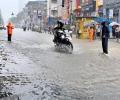
Mumbaikars woke up to very heavy rainfall on Monday, while the India meteorological department (IMD) issued a 'red' alert, forecasting extremely heavy rains at isolated places in the city and adjoining areas, prompting the civic body to declare a holiday for schools and colleges, officials said.
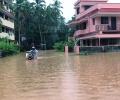
Heavy monsoon rains battered Karnataka's coastal belt for the third consecutive day on Monday, severely disrupting normal life in Dakshina Kannada district, prompting authorities to issue a red alert and deploy disaster response teams. A red alert indicates extremely heavy rainfall of over 20 cm in 24 hours, and will remain in force for the next five days, according to the India Meteorological Department (IMD). Several parts of Mangaluru city reported waterlogging and traffic snarls, while minor incidents of landslides were reported from hilly regions across the district. The district administration has directed schools and composite colleges to remain shut on 27 and 28 following the IMD issuing a red alert. Instructions were also issued to relocate residents living in vulnerable hillside and riverside areas to safer locations. The authorities have sought prompt action from the National Highways Authority of India (NHAI) following complaints of water intrusion in residential areas due to ongoing highway construction works.

The minimum temperature in Delhi was recorded at 28.6 degrees Celsius, according to the India Meteorological Department (IMD).

In Rajasthan, Pilani recorded 44.9 degrees Celsius, Phalodi and Churu touched 43.8 degrees Celsius and 43.5 degrees Celsius respectively, while Bikaner and Jaipur registered 43.4 degrees Celsius and 43 degrees Celsius.

The last time the southwest monsoon arrived earlier than in 2025 -- that is, back in 2009 -- the rains lost steam after the early onset and ended the season with almost 23 per cent deficient rainfall, which was the lowest recorded average rainfall in several decades over India.

Over the past few days, deaths due to heat stroke have been reported from different parts of the country including Uttar Pradesh, Bihar and Odisha.

Among the fatalities recorded on Friday, the maximum 17 were from Uttar Pradesh, 14 from Bihar, five from Odisha and four from Jharkhand, where officials said more than 1,300 people are hospitalised with heatstroke conditions.
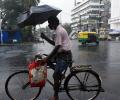
The Southwest Monsoon is set to arrive early with the Andaman and Nicobar Islands expected to receive first seasonal showers on May 15, the weather office said on Thursday.

Bhavnagar was also one of the worst affected districts, they said, adding that more downpour is likely over the next four day in parts of the state.

After a long and harsh spell of heatwave, Delhi witnessed a pleasant morning on Thursday, with the weather department saying parts of the national capital received light rains.

All 80 people stuck at Pali waterfall in Goa's Sattari taluka were rescued on Sunday by the state's Fire and Emergency Services and the police, an official said.

Residents of North India battle freezing conditions.

The labourers, who are said to be of Nepali origin, were engaged in the construction of a hotel.

The Supreme Court has requested the Election Commission to respond to petitions challenging the Special Intensive Revision of electoral rolls in Tamil Nadu and West Bengal. The court has also asked the Madras and Calcutta High Courts to keep proceedings on similar petitions in abeyance.

Skymet expects a good monsoon over western and southern India.

There was no report of any major water-logging anywhere in the city so far.

Satellite imagery showed a layer of dense fog extending from Punjab and north Rajasthan to the northeast. Patches of fog were also visible along the east coast.

Heavy overnight rains severely affected parts of the city on Monday, leading to water-logged roads, inundated residential areas and traffic pile-up, as the city braces for more spells in the coming days.

IMD data shows in the 24 hours between September 1 and 2, Haryana received 806 per cent more rainfall than normal, Punjab 759 per cent, Himachal Pradesh 510 per cent, Delhi 740 per cent, Chandigarh a staggering 1,638 per cent, and Rajasthan 193 per cent.

Delhi saw seven cold wave days in January 2020, while it did not record any such day last year.

The Indian Meteorological Department has issued a forecast predicting significant precipitation in the city throughout the week, casting a shadow over the series opener.

Cyclone Ditwah exits Sri Lanka after causing widespread destruction and over 120 deaths, heading towards the Indian coast. Heavy rains and high winds are expected to continue.

Delhi is experiencing its first heatwave of the season, with temperatures reaching 40.2 degrees Celsius. Doctors have warned that exposure to extreme heat can lead to a range of health issues, from mild rashes and muscle cramps to serious conditions like heat exhaustion and heatstroke. They advise staying hydrated, avoiding outdoor activities during peak hours, and wearing light, breathable clothes. Vulnerable groups like children, the elderly, and those with pre-existing conditions are at greater risk.

The India meteorological department on Monday issued an 'orange alert' for Mumbai and Thane signalling very heavy rainfall till June 21.

Wheat production during the current season is expected to be better than last year provided the weather remains favourable over the next few weeks, said senior industry executives. The weather had turned uncharacteristically hot in the latter half of last month, but owing to strong winds, the chill has returned in the last few days.

Heavy rainfall across North India leads to fatalities, structural damage, travel disruptions, and school closures. Eastern states brace for more rain.

More than 150 express/passenger trains running through South Eastern Railway jurisdiction have been cancelled in view of the severe cyclonic storm, an SER official said.

Moody's Investors Service on Friday raised India's growth projection for 2023 calendar year to 6.7 per cent on account of robust economic momentum. "Strong services expansion and capital expenditures propelled India's 7.8 per cent real GDP growth in the second (April-June) quarter from a year ago. "We have accordingly raised our 2023 calendar year growth forecast for India from 5.5 per cent to 6.7 per cent," Moody's said in its Global Macro Outlook. - el nino

Delayed by 10 days due to cyclone Biparjoy, southwest monsoon is likely to progress further and hit Mumbai between June 23 and 25, the India meteorological department said on Wednesday.
